
David Orrell. Writer and Mathematician
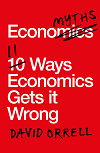
Economyths: 11 Ways Economics Gets It Wrong
Other editions
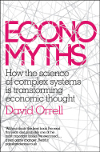
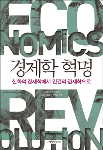
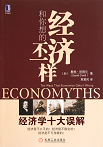
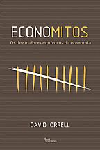
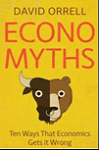
Revised and extended 2017 edition
Earlier editions: Icon (UK), Wiley (North America), Record (Brazil), China Machine Press (China), Hikmah (Indonesia), Kawadeshobo (Japan), Planet B (Korea)
» Finalist: National Business Book Award (Canada)
» Over 40,000 copies sold
Publisher's synopsis
Economyths upends the basic tenets of economic thought, and points the way to a new understanding of the economy. When the book was first published in 2010, David Orrell showed how mainstream economics is based on key myths such as fair competition, rational behaviour, stability, and eternal growth - and how these myths feed into the real economy, leading paradoxically to their opposites: inequality, an irrational economy, financial instability, and a collision with nature's limits.
Since then, we've had the Occupy movement, political upheaval, flash crashes in financial markets, the warmest few years in recorded history - and a growing chorus of voices demanding fundamental reform. So how has economics responded?
In this revised and expanded edition, Orrell shows how the ten myths still dominate economics. He reveals their roots in a tradition of thought that goes back to the ancient Greeks, making them hard to dislodge. And in a new final chapter, he uncovers, demolishes, and develops an alternative to the greatest economyth of all - the one that will lead to the collapse of orthodox economics.
“A fascinating, funny and wonderfully readable take down of mainstream economics. Read it.” Kate Raworth, author of Doughnut Economics
“When I saw this book I was rather excited, because I loved Freakonomics and I rather hoped this was going to be more of the same. It wasn't. It was so much more. This is without doubt the best book I've read this year, and probably one of the most important books I've ever read ... This ought to be a real game changer of a book. Read it.” Brian Clegg, author of Before the Big Bang: The Prehistory of Our Universe, writing at popularscience.co.uk
“Lists 10 crucial assumptions (the economy is simple, fair, stable, etc.) and argues both entertainingly and convincingly that each one is totally at odds with reality. Orrell also suggests that adopting the science of complex systems would radically improve economic policymaking.” William White, OECD (Bloomberg Best Books of 2013)
“Consistently interesting and enjoyable reading ... A wide audience including many non-economists could benefit from reading it.” International Journal of Social Economics
“Highly readable and a great introduction to the dynamic thinking used in many natural sciences.” The Post-crash Economics Society
“A must read for understanding the roots of the financial crisis, the severe limitations of the field of economics and what needs to be done to improve our ability to avoid future crises.” Spyros Makridakis, author of Dance With Chance: Making Luck Work for You
“Intellectually stimulating.” Toyo Keizai (Japan)
“His ten economic myths should be committed to memory.” Monthly Review
“I urge you all to read [this book]” New Straits Times (Malaysia)
“A wonderful book.” Chetan Parikh, director of Jeetay Investments Private Limited (India)
“Thought provoking ... elegantly written.” James Picerno, author of Dynamic Asset Allocation: Modern Portfolio Theory Updated for the Smart Investor, writing at Seeking Alpha
“Orrell takes on the efficient market hypothesis ... equilibrium theory ... problems of risk modelling ... and unsustainable assumptions about rationality, fairness, limitless growth, and so forth. His tone is engagingly curious, drawing on biology and psychology, and his historical view spans more than merely the past few decades. Finally Orrell recommends an interdisciplinary approach to a 'new economics', in which ethics and complexity theory might have a say.” Guardian (UK)
“I have found this book to be very humorous, the historical titbits are especially amusing and educational.” Leah Walker, 580 CFRA Radio Ottawa
“Economyths is required reading for anyone who deals with the economy.” Obserwator Finansowy (Poland)
“An excellent book.” Io Non Ci Casco Più (Italy)
“Analyses reliably and convincingly the claim of economics to quasi-scientific objectivity and mathematical accuracy and exposes as a sales ploy that which made economics the queen of the social sciences.” Norbert Häring, author of Economics 2.0
“Invoking history, physics, biology, climatology and his background in complex systems to debunk neoclassical economics, Orrell makes a plea for an unorthodox economics, one drawing on ethics and environmentalism as well as emerging areas of mathematics like non-linear dynamics and network theory.” Canadian Business magazine
“Entertaining, informative and highly recommended.” Millier Dickinson Blais newsletter
“A book that can help you appreciate economics in action, and also help make it less of a voodoo science.” The Hindu (India)
“One of the best economics books of the year.” Pressian.com (South Korea)
“Read this book!” Indonesian Society for Social Transformation
Blogs: Today's economy, Capital Ideas Online, Earnest and Jest, Now Appearing, Aid on the Edge of Chaos, Seeking Alpha, U of M SSA, RYviewpoint, Change My Worldview
Interviews: Business News Network, Monocle 24, TheStreet.com, Lang and O'Leary Exchange on CBC TV, The Globe and Mail, National Post, Breakfast Television Toronto, CFRA Ottawa, BBC World Service, Parkiet (Poland), Sun Life Financial